Wedding and event halls, in Egypt
Farha
A system in Arabic that runs a wedding and event hall from the first inquiry to the closing of the cash drawer: the date, the quote, the contract, the payments and the night itself.
- System type
- Management system for wedding halls: bookings, quotes, contracts, money, event operations, accounts and reports, on laptop, phone and receipt printer
- Our role
- Full build — starting from how a hall really runs, from the first call to the closing of the drawer, then building and checking it screen by screen
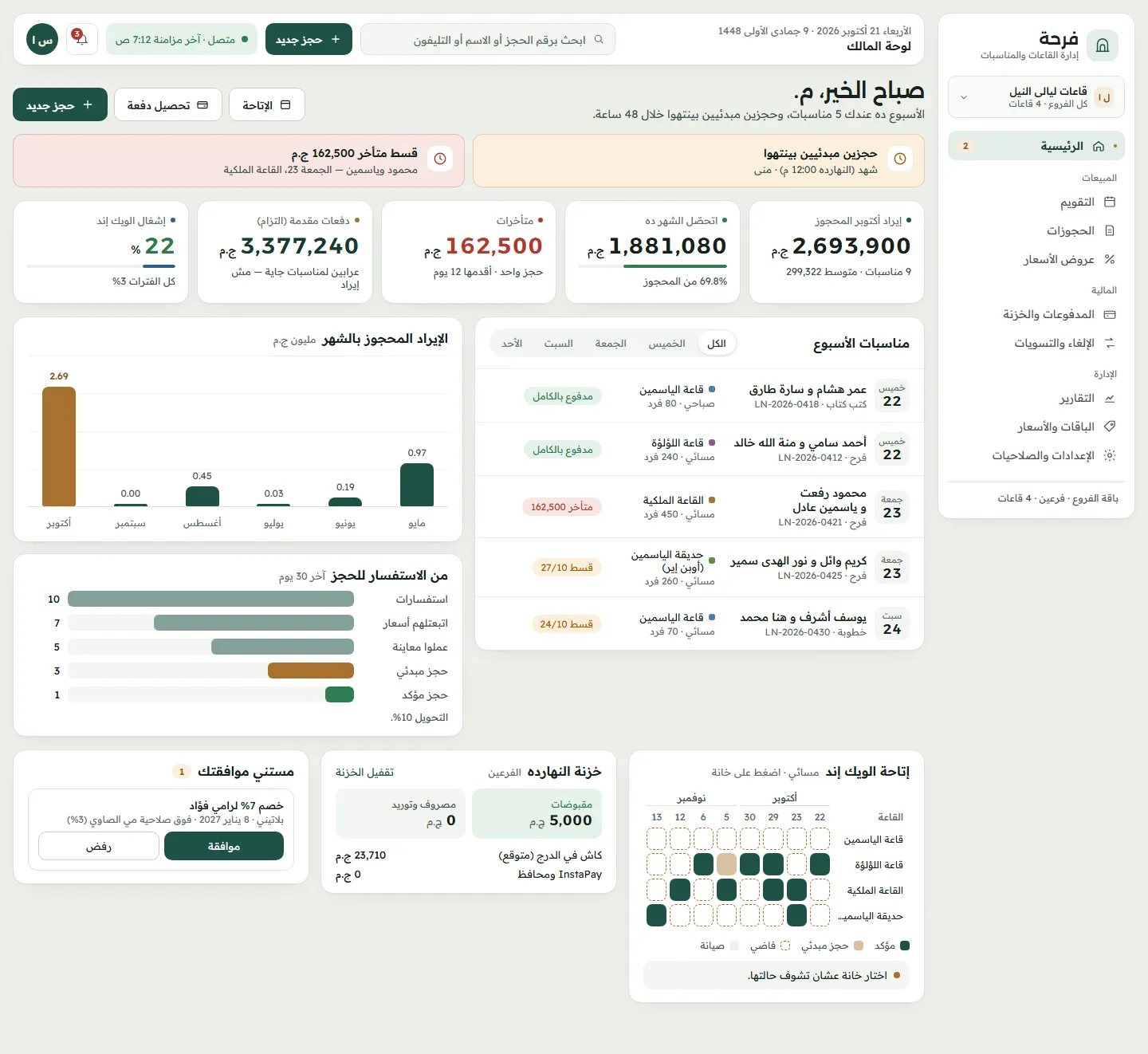
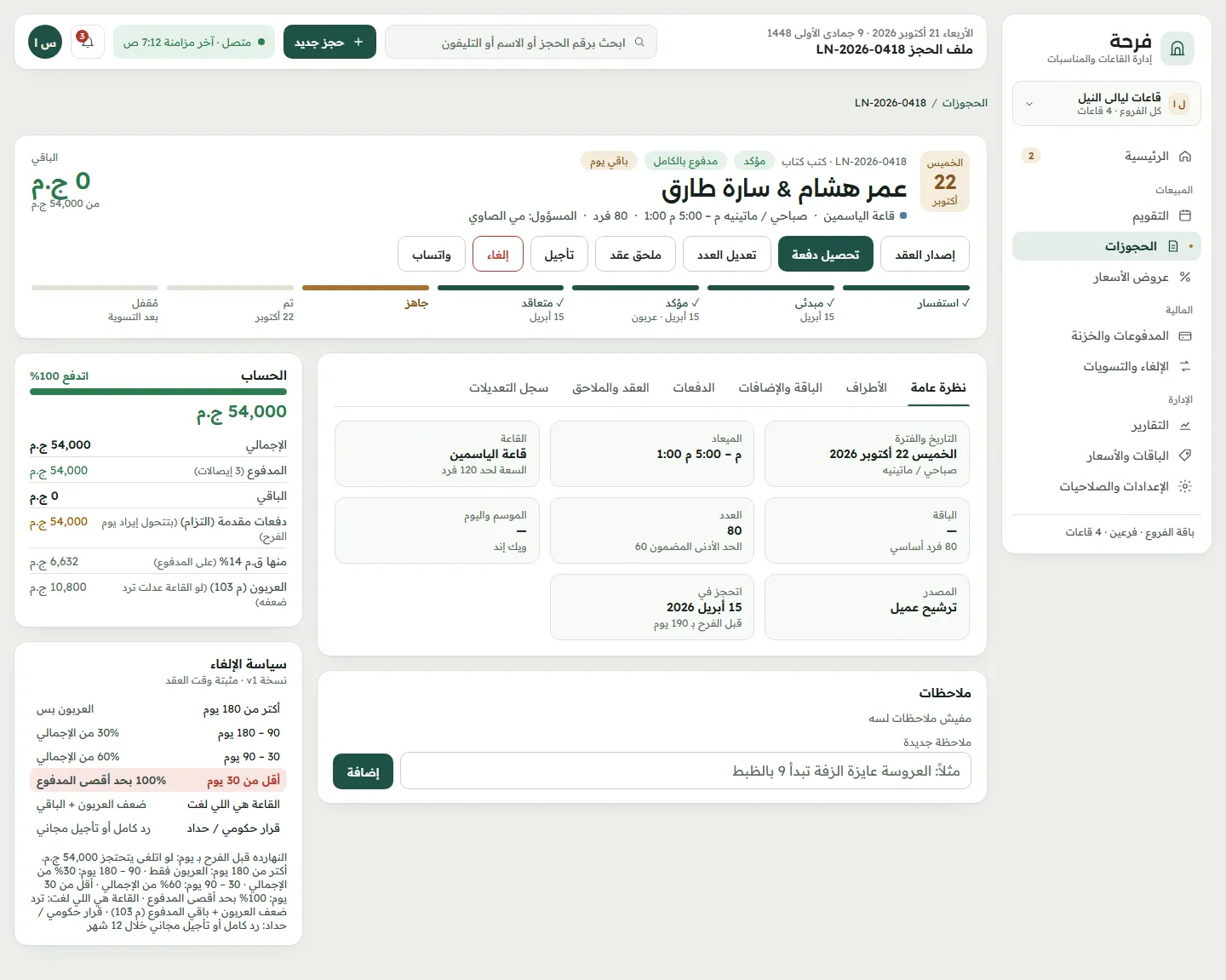
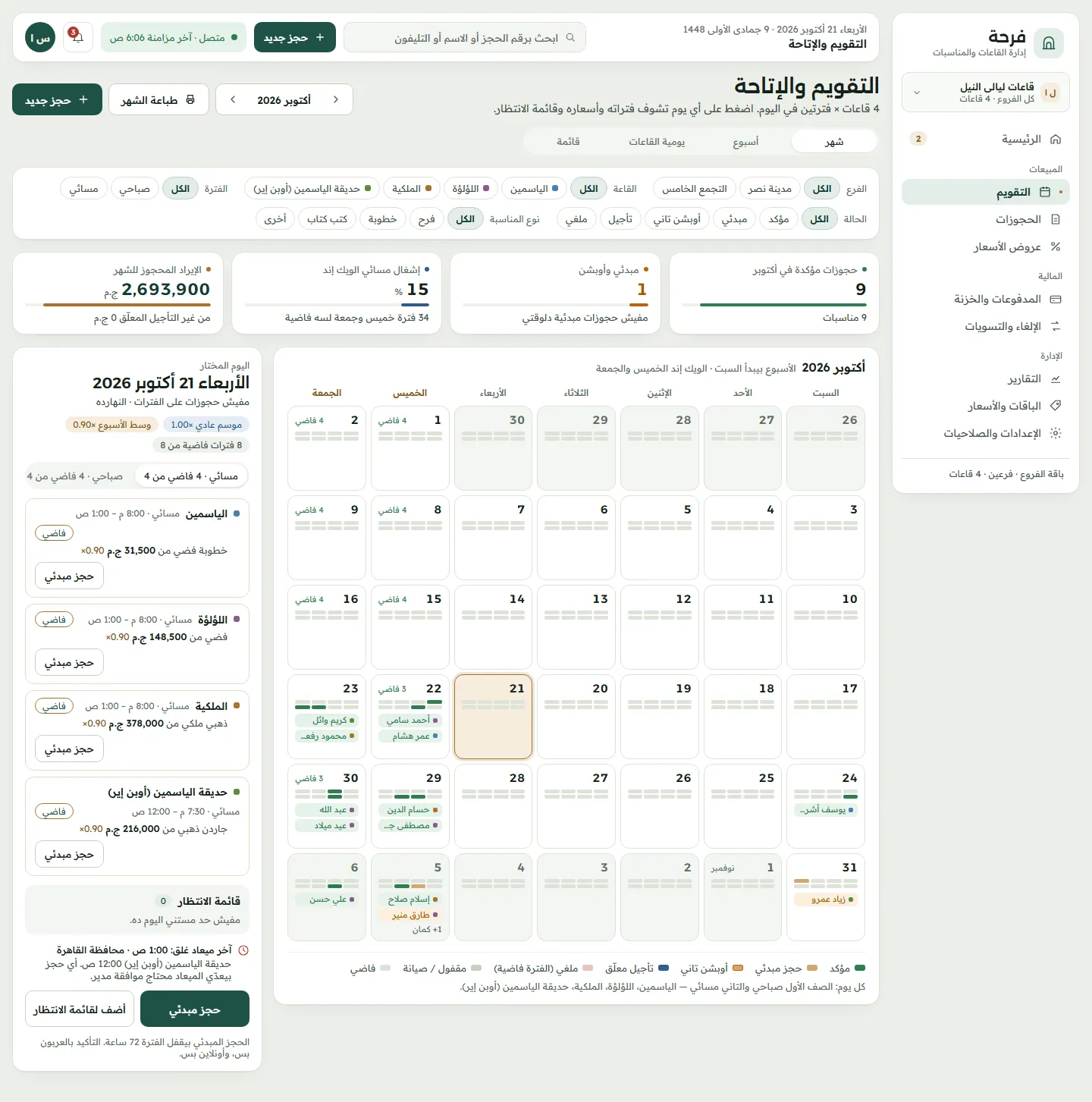
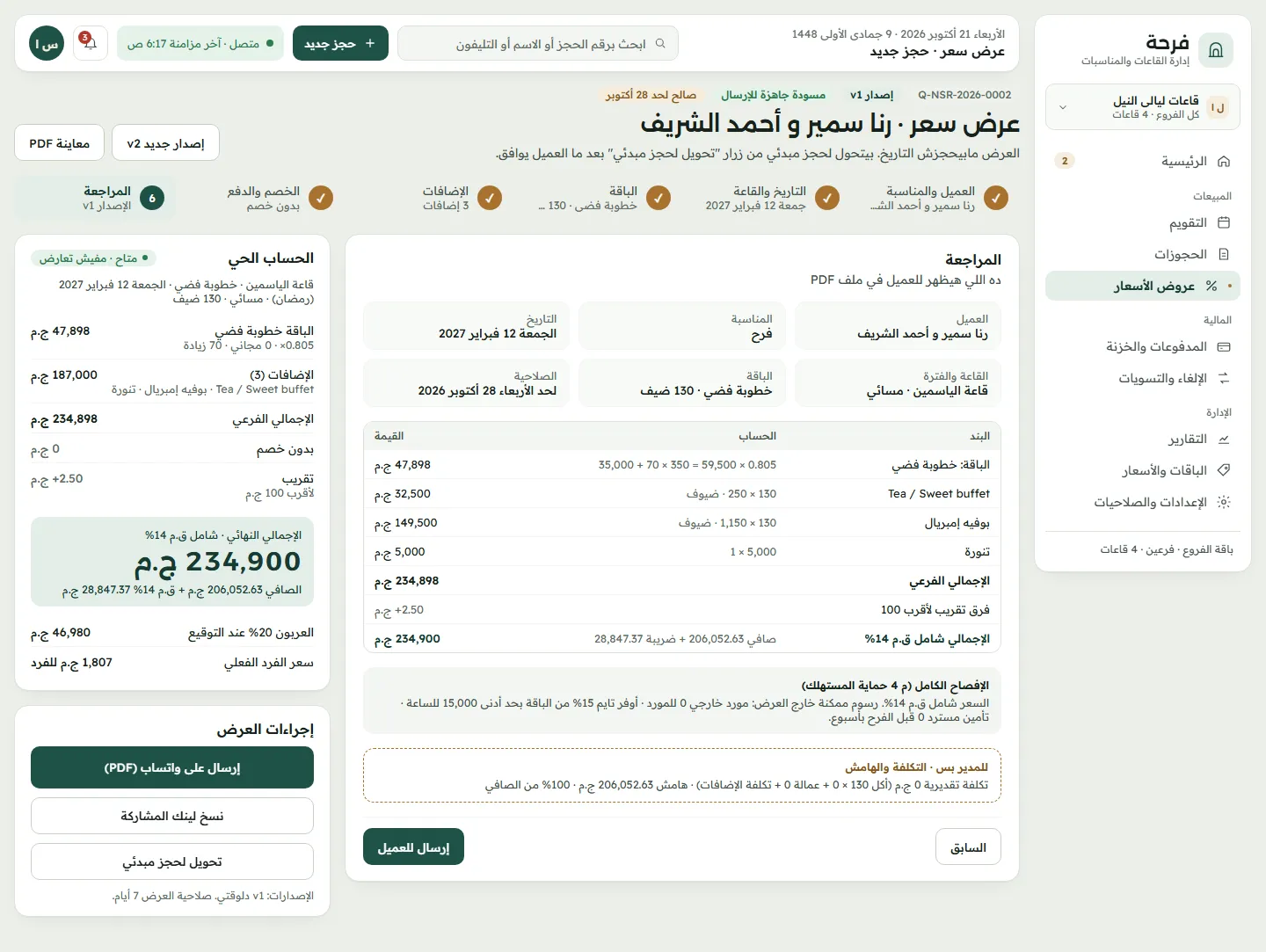
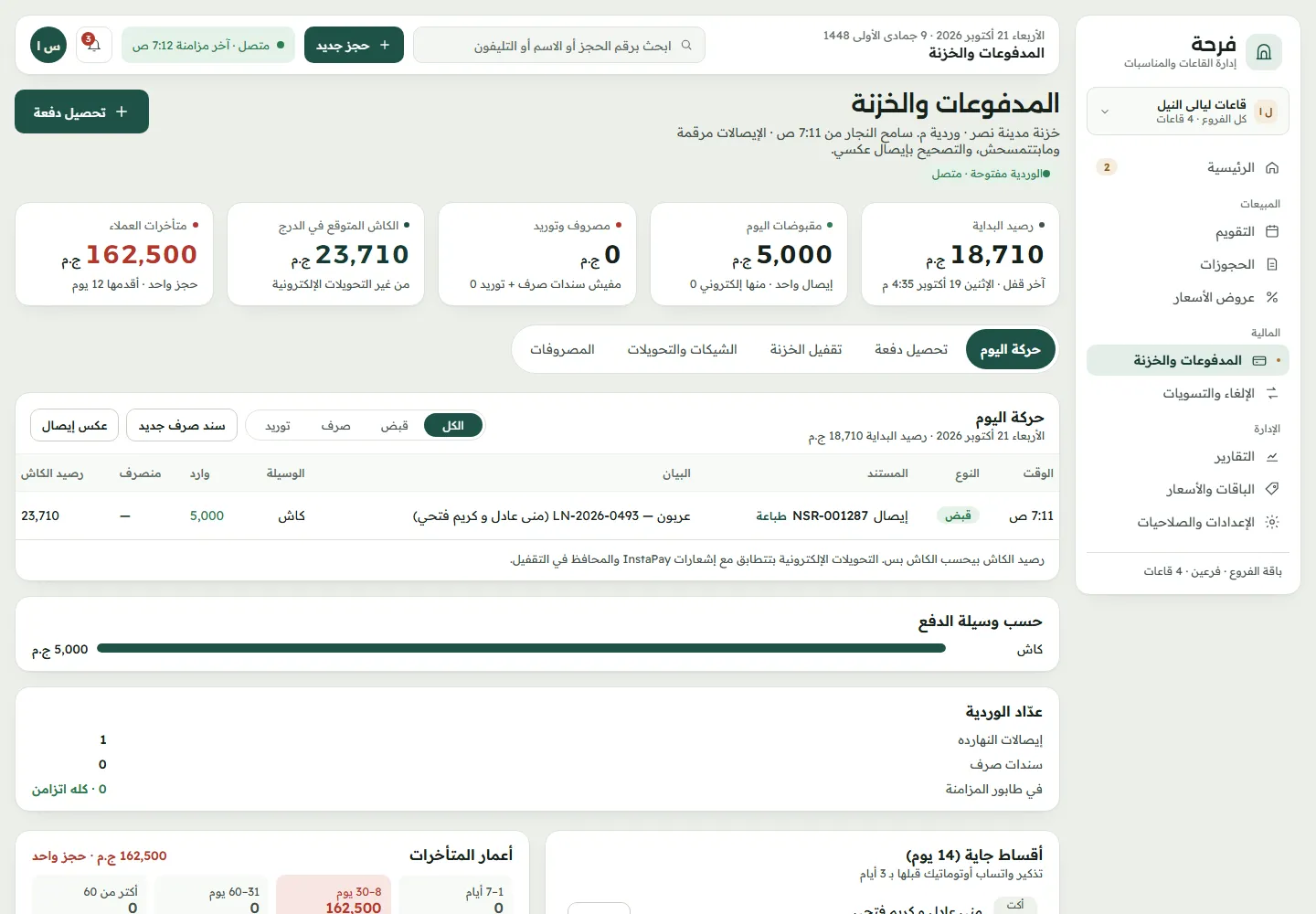
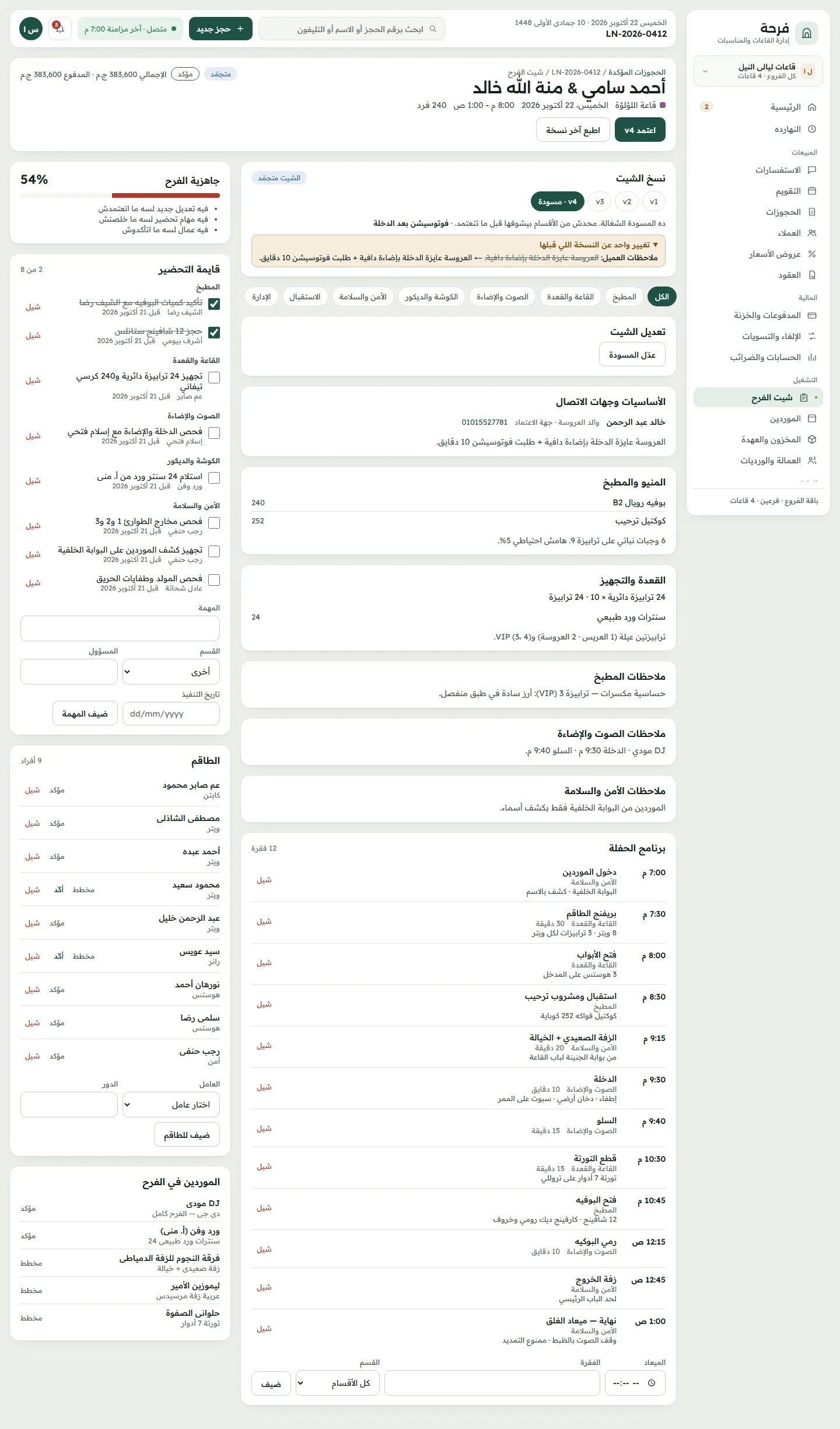
A system that carries a hall from the first inquiry to the end of the night. A date can be held for a deadline, the quote is priced by season, day, period, package and guests, and the contract, the deposit and every later payment follow on from it, with numbered receipts that show the amount in words and the VAT. On the night, the captain runs the programme from a phone and the client signs for extras with a finger; afterwards the account is settled and the cash drawer is closed by counting the notes. Two requests for the same hall and slot can never both win, a signed contract is never edited, and every change leaves a record. The interface is Arabic, right to left, on laptop and phone, and prints on A4 and on an 80 mm receipt.
- 88
- screens in the system
- 8
- roles, each with its own view
- 193
- permissions the owner can assign
- 14%
- VAT worked out on every receipt
- Sector
- Wedding and event halls
- System type
- Management system for halls with one or more branches
- Coverage
- Inquiries, bookings and calendar, quotes, contracts, payments and cash drawer, event sheet and night, vendors, inventory and staff, accounts, reports, packages and prices, permissions
- Screens
- 88
- Users
- Owner, branch manager, sales, cashier, operations, captain, storekeeper, HR
- Language and direction
- Arabic interface, fully right to left
- Devices and print
- Laptop and phone, A4 documents and an 80 mm thermal receipt
- Currency and tax
- Egyptian pounds, 14% VAT
A hall sells one night, and the night was kept on paper
These are the problems a wedding hall meets when it runs on a paper diary, a spreadsheet, WhatsApp messages and the cashier's memory, and the system was built around them. This section describes working practice, not a measurement of how any one hall worked.
Read the detailHide the detail8 points
- Booking
- — Without a hard rule on the calendar, the same hall and slot can be promised to two clients at the same moment.
- Pricing
- — The price moves with the season (Ramadan, quiet months), the day (midweek, weekend, Saturday), the period (morning or evening), the package and the number of guests, and it is easy to quote it differently from one employee to the next.
- The deposit
- — It is treated in law as an earnest deposit that either side may give up, so what happens to it on a cancellation or a postponement has to be agreed in writing.
- Money
- — Receipts have to be numbered in sequence, the drawer has to be closed by a real count, and half the money moves by cash, InstaPay and transfer.
- The night
- — Damages, tips and overtime are added up at the end of the evening, and have to be charged to the client exactly.
- Before the booking
- — Inquiries arrive from WhatsApp, Instagram, the phone and middlemen, and visits and follow-ups get lost if they are not written down in one place.
- Preparation
- — Every department (kitchen, sound, décor, security) needs an up-to-date copy of the same sheet, and staff and vendors can be booked for two events on one night.
- Accounts
- — The outside accountant needs entries and statements that balance, and money received in advance must not count as income before the day of the event.
Built around the booking
Read the detailHide the detail
We started from the way a hall actually runs: the hall, the period, the package, the contract, the payments, the close. Each business rule is written once, in one place, so a quote, a receipt and a contract can never disagree with each other.
Who may see and do what is decided inside the system itself, not just on the screen, and the interface was built in Arabic from the start rather than translated over an English one.
We built it screen by screen and checked each one on a laptop and on a phone before moving on.
A booking, from the first inquiry to closing the drawer
A booking moves through nine steps in a fixed order, and the same booking number appears on every screen and every document along the way.
A GOVERNED LOOP9
- 01Inquiry
- 02Tentative hold with a deadline
- 03Quote
- 04Confirmation with a deposit
- 05Contract
- 06Collecting payments
- 07The night of the event
- 08Settling the account
- 09Closing the cash shift
- Back to 01
Read the detailHide the detail16 points
- 01
Inquiry
Every inquiry is recorded with where it came from, the type of event, the guest count and the budget, and visits are booked with an automatic reminder.
- 02
Tentative hold with a deadline
The date is held for a set time. If the client does not answer, the hold expires on its own and the hall goes back on sale.
- 03
Quote
The price is worked out live as the date, hall, package and add-ons are chosen, and the client gets a link to the quote.
- 04
Confirmation with a deposit
The booking is confirmed once the deposit is taken, and the cancellation and postponement terms are fixed.
- 05
Contract
The contract is built from the clauses and the booking, printed on A4 and signed.
- 06
Collecting payments
Each instalment is taken at the cashier screen or on a phone, and each one gets a numbered receipt.
- 07
The night of the event
Each department works from its own part of the event sheet, and the captain runs the programme and the door count from a phone.
- 08
Settling the account
Damages, tips and overtime are added, the security deposit is applied, and what the client owes or gets back is worked out.
- 09
Closing the cash shift
The drawer is counted note by note and compared with what was expected.
No double booking
Two requests for the same hall and slot cannot both succeed. One wins and the other becomes a second option, even if both arrive in the same moment.
Pricing by season, day, period, package and guests
Every quote uses the venue's own multipliers, so the same event gets the same price whoever writes the quote.
The deposit is an earnest deposit
It is handled as an earnest deposit under the Egyptian civil code, and what happens to it on a cancellation or a postponement is fixed when the contract is signed.
Receipts are numbered in sequence
Each cash drawer has its own unbroken numbering, and every receipt shows the amount in words and the VAT.
The drawer is closed by counting
The cash is counted by denomination, and any difference from what was expected needs a manager's approval before the shift closes.
A signed contract is never edited
A signed contract is locked. Any later change goes in an addendum, and the original stays as it was signed.
The night's extras are signed by the client
Damages, tips and overtime are charged only after the client signs for them on the screen with a finger.
The same sequence applies to every employee and every booking, and the owner can see each step afterwards.
The departments
88departmentsONE PLATFORM
- Sales
- Bookings and calendar
- Money
- Event operations
- Vendors, inventory and staff
- Accounts and compliance
- Reports
- Administration
Read the detailHide the detail8 points
- Sales
- Inquiries by stage, visits, quotes, contracts, the couples' portal, and a public page showing which dates are free without names or prices.
- Bookings and calendar
- A month, week and day calendar for every hall and branch, with tentative holds, second options and a waiting list.
- Money
- Payments, numbered receipts, the cash drawer and its shifts, and the settlement of a cancellation or postponement.
- Event operations
- An event sheet for each department with versions, the captain's screen on the night, and extras signed by the client.
- Vendors, inventory and staff
- Vendors and what each is owed, inventory and custody with damage reports, and staff scheduling with a warning on clashes.
- Accounts and compliance
- Journal entries made automatically, deferred revenue, the trial balance and statements, CSV files for the accountant, licences and hall capacity.
- Reports
- Profit per event, the inquiry funnel and why inquiries were lost, vendor payables and the owner's dashboard.
- Administration
- Roles and permissions, approval limits, custom fields, a simple mode for a small hall, and a day's work that carries on offline.
Arabic first, and built for the phone
The interface is Arabic and runs right to left on every screen. The screens used in the field — the calendar, taking a payment, the owner's summary — are made for touch.
Read the detailHide the detail5 points
- A bottom bar with the main destinations, and a button always at hand for a quick booking.
- Wide tables turn into cards on a small screen.
- A day's work stays available on a linked device if the internet drops.
- Search ignores the difference between أ, إ and آ, between ة and ه, and between ى and ي.
- Dates, numbers and tables run in the Arabic reading direction, not mirrored over an English layout.
The owner's summary on the phone
The screens
59 screensThe system and its screens are real; the data in the screenshots is not. The venue («قاعات ليالي النيل»), the clients, the staff and every amount are demo data for an invented venue, not real operating data, and belong to no real hall or client.
The booking journey
Operations
Permissions and audit
Sales
Event operations
Finance and compliance
Platform
What changes in how a hall runs
| How a hall typically runs | With Farha |
|---|---|
| A paper diary or a spreadsheet for bookings | One calendar that refuses overlaps |
| Pricing done by hand, differing from one employee to the next | A quote worked out from the venue's own multipliers |
| Receipts written by hand | A numbered receipt with the amount in words, VAT and where the account stands |
| Working out the night's account on paper | Damages, tips and overtime settled automatically |
| A drawer counted from memory | A count by denomination matched to what was expected |
| Permissions by word of mouth | Roles, limits and approvals on record |
| Inquiries scattered across WhatsApp, Instagram and the phone | One board of inquiries by stage, with visits and reminders |
| The outside accountant rebuilds the books from papers | Entries made automatically, statements that balance, and CSV files for the accountant |
How a hall typically runs
A paper diary or a spreadsheet for bookings
With Farha
One calendar that refuses overlaps
How a hall typically runs
Pricing done by hand, differing from one employee to the next
With Farha
A quote worked out from the venue's own multipliers
How a hall typically runs
Receipts written by hand
With Farha
A numbered receipt with the amount in words, VAT and where the account stands
How a hall typically runs
Working out the night's account on paper
With Farha
Damages, tips and overtime settled automatically
How a hall typically runs
A drawer counted from memory
With Farha
A count by denomination matched to what was expected
How a hall typically runs
Permissions by word of mouth
With Farha
Roles, limits and approvals on record
How a hall typically runs
Inquiries scattered across WhatsApp, Instagram and the phone
With Farha
One board of inquiries by stage, with visits and reminders
How a hall typically runs
The outside accountant rebuilds the books from papers
With Farha
Entries made automatically, statements that balance, and CSV files for the accountant
This table describes the change in working practice. No operating figures are shown: nothing was measured.