Industrial manufacturing · Live in production
A fully custom ERP for a manufacturer
From paper, Excel and WhatsApp to one platform covering 13 departments.
- Client
- Good Steel Chute Systems — Manufacture and installation of waste and refuse chute systems
- System type
- Fully custom ERP — built around the company’s actual operations, not an off-the-shelf package bent to fit
- Build time
- ~10 weeks
- Our role
- End to end — discovery, design, build, deployment
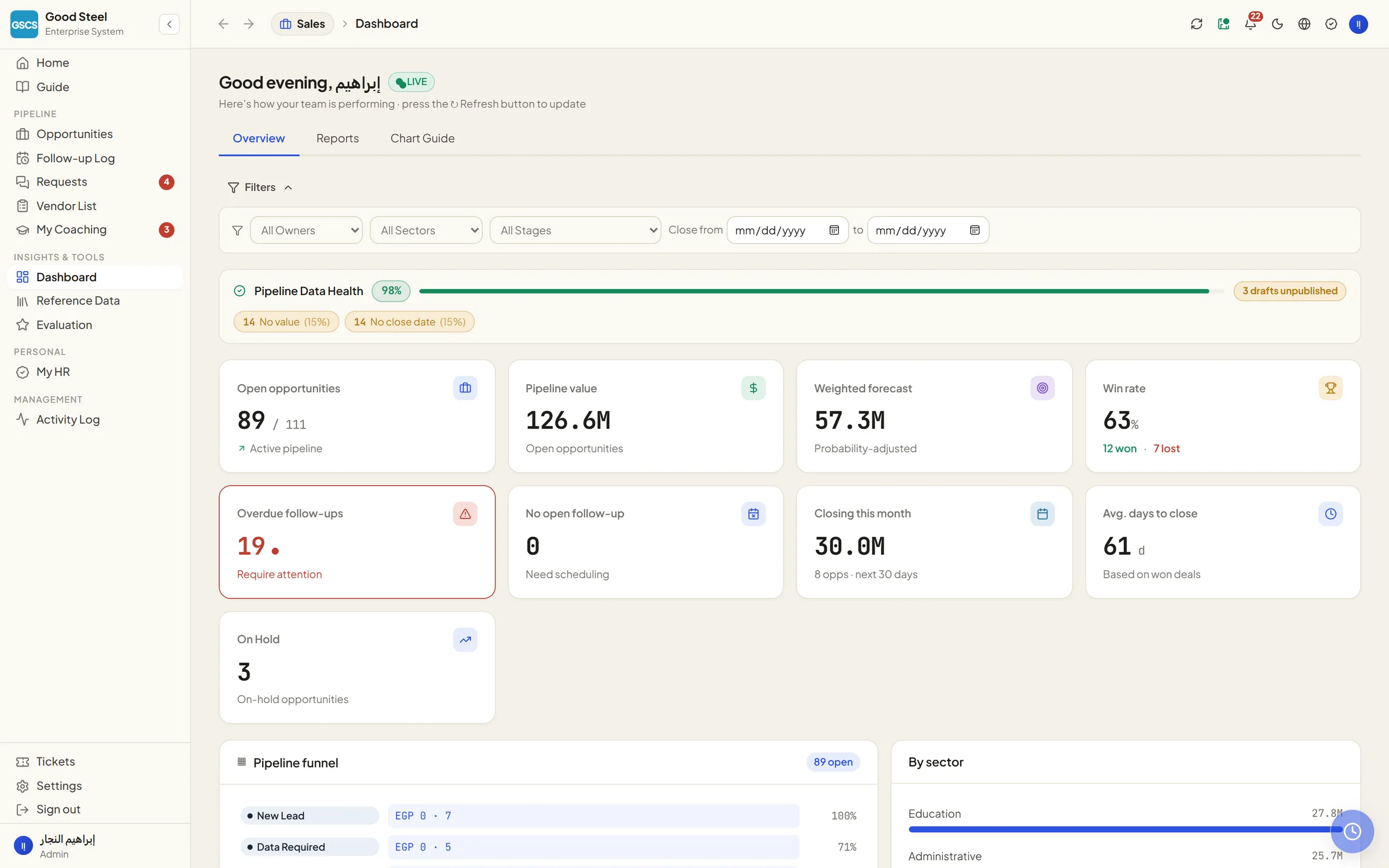
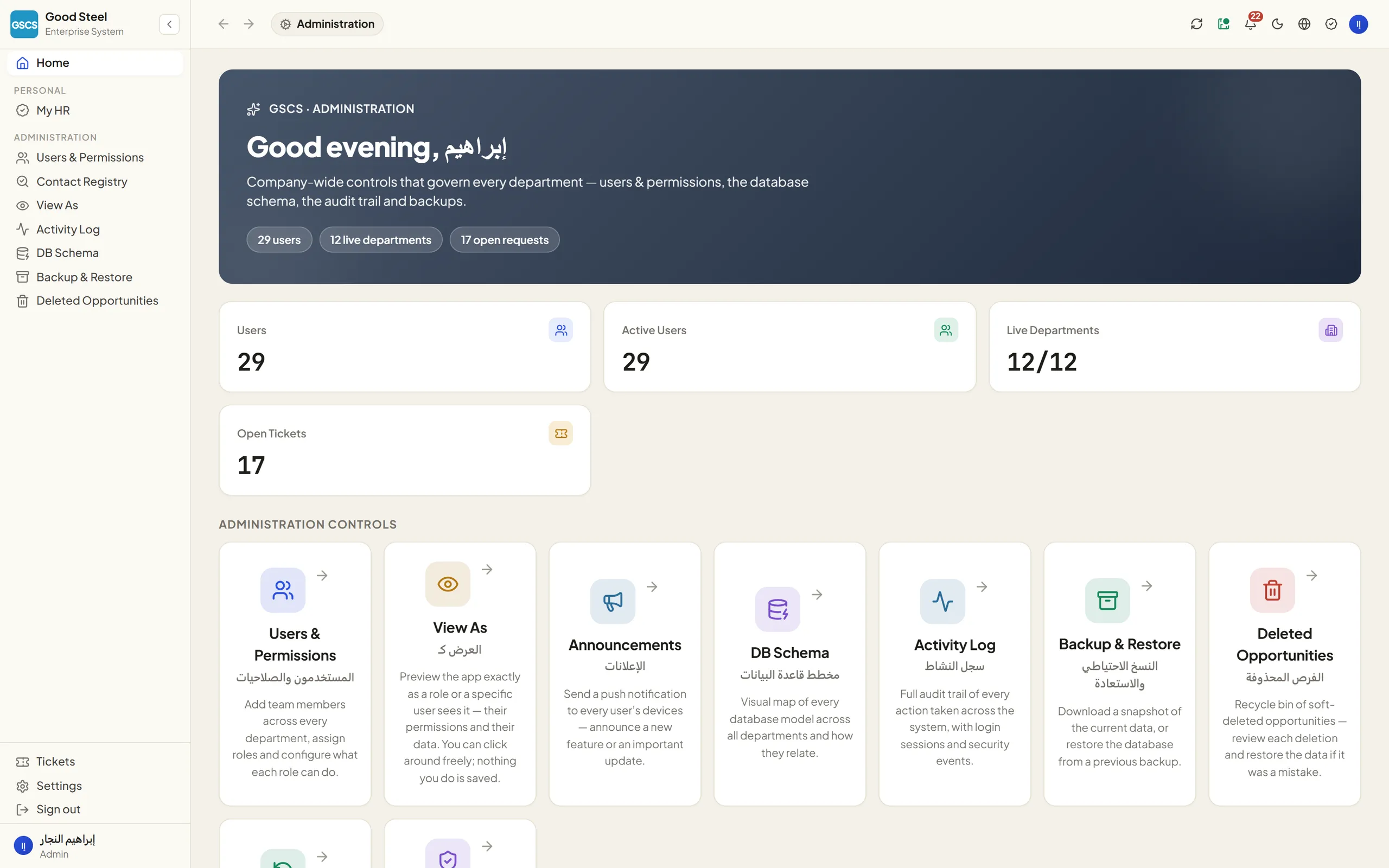
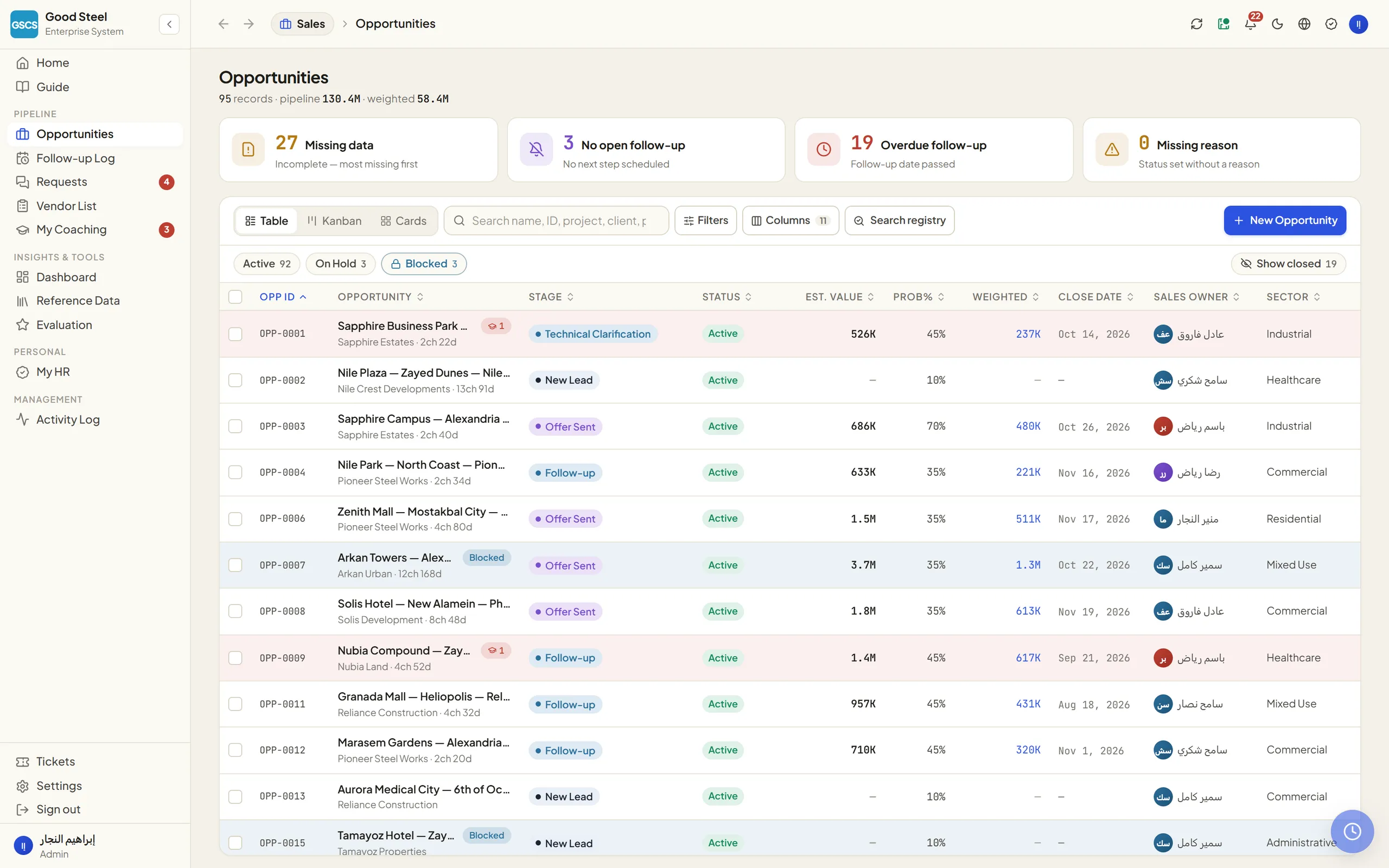
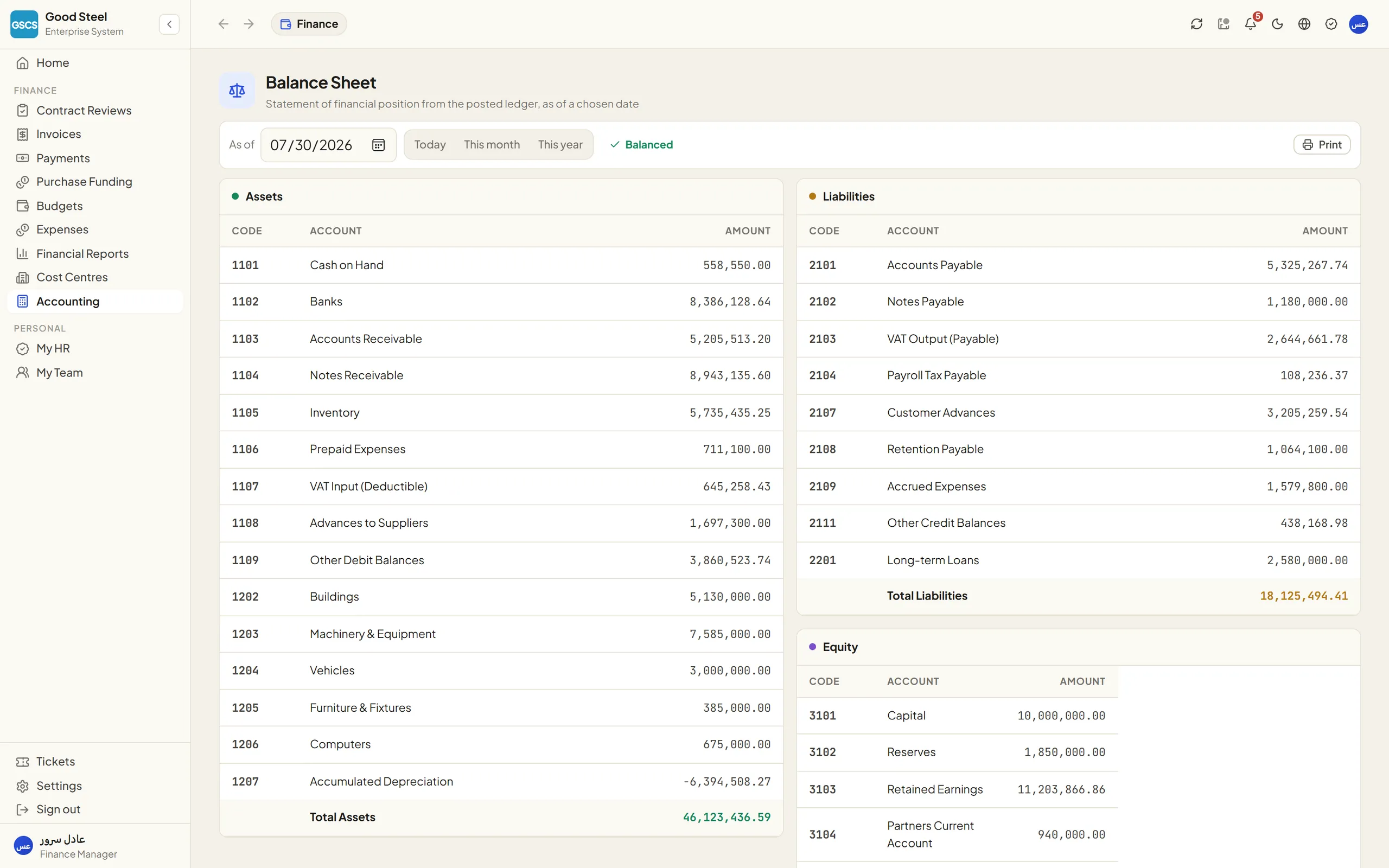
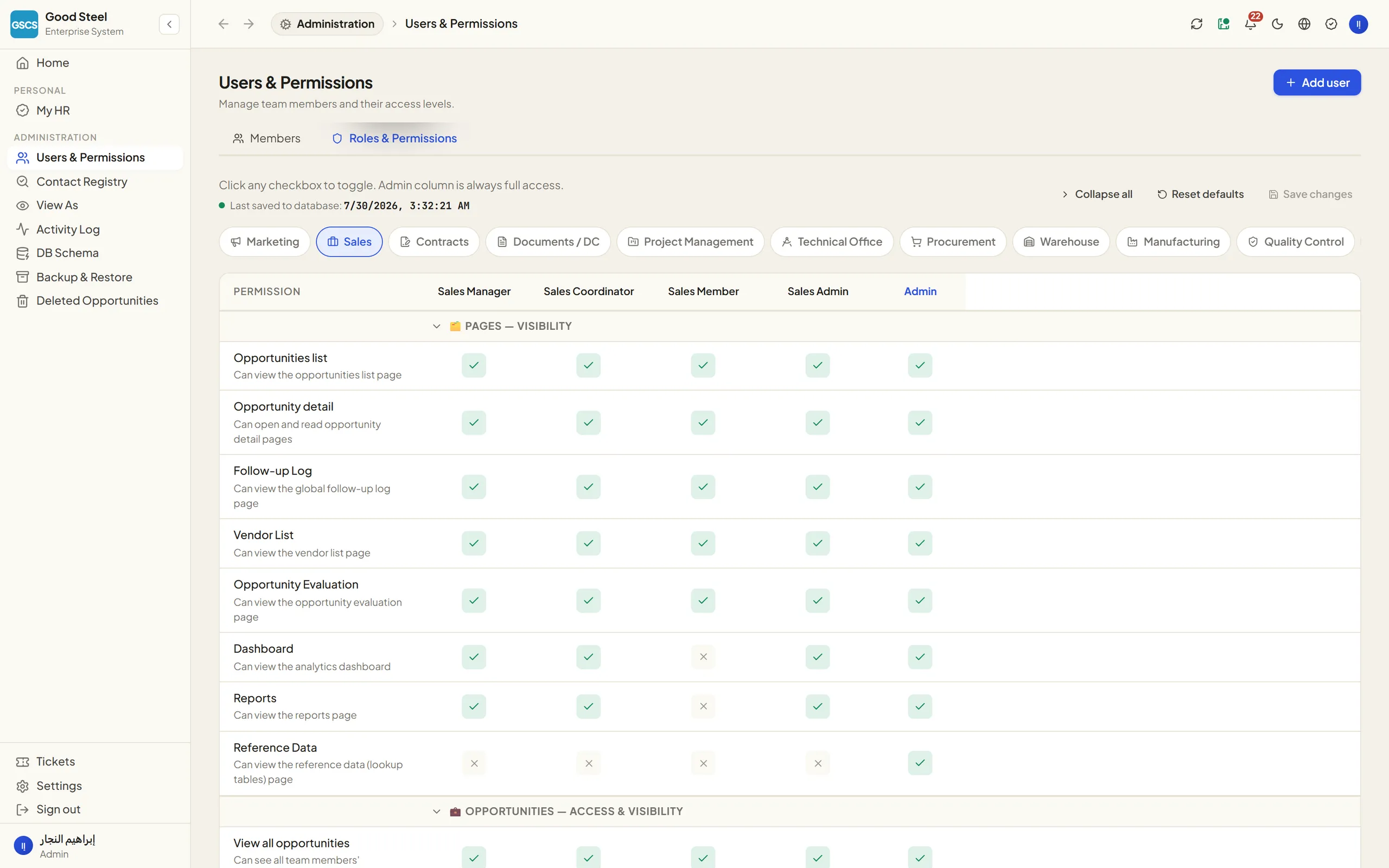
We took a manufacturer whose entire operation was spread across paper, Excel, WhatsApp and a separate program for every department, and replaced it with one platform covering 13 departments — from the first customer call to the quote, the contract, manufacturing, the warehouse, quality, on-site installation, the invoice and the accounting entry — in one interface, with data entered once, and a record of every movement.
- 13
- departments
- 191
- screens
- 384
- API endpoints
- 192
- database tables
- 17,057
- bilingual strings
- 50–100
- internal users
- ~10
- weeks to production
- Sector
- Industrial manufacturing and installation — chute systems for residential and commercial towers, hotels and hospitals
- System type
- Fully custom ERP, built around the company’s actual operations
- Coverage
- 13 departments · 191 screens · 384 API endpoints · 192 database tables
- Users
- 50 to 100 internal users, with different permissions for every role
- Languages
- Fully Arabic + English with real RTL support — 17,057 translated strings
- Devices
- Desktop, tablet and mobile (iOS and Android) — staff work from site the same way they work from a desk
- Build time
- ~10 weeks from nothing to live operation
The problem before the system
The company works in a field that combines technical selling, manufacturing and installation on construction sites — three worlds that operate nothing like each other. The result was that every department built its own tools.
Read the detailHide the detail8 points
- Sales
- — tracked opportunities in Excel files, and follow-ups lived in someone’s head or on WhatsApp.
- Pricing
- — was calculated by hand from scratch every time, so the price changed depending on who calculated it.
- Contracts and documents
- — were printed paper plus folders on different machines, and any review meant hunting for the latest version.
- Warehouses
- — ran on handwritten sheets, and the real balance was only known after a stocktake.
- Procurement
- — happened by phone and WhatsApp, and supplier offers were compared on a sheet of paper.
- Sites
- — requested material by message, material was issued on a slip, and consumption was recorded later — or not at all.
- Finance
- — re-entered everything from the beginning, because it did not trust anyone else’s numbers.
- HR
- — kept attendance, leave and payroll on paper and in Excel.
The core problem was not a shortage of tools. It was that the same piece of data was re-entered in every department, which produced conflicting versions of the truth with no way to tell which one was right. Alongside it sat real problems that existed but were invisible: dead stock, neglected opportunities with no follow-up, quantity discrepancies, and purchase orders nobody could explain.
Understand how the work actually runs, then build on it
Read the detailHide the detail
We did not start by writing code. We started by sitting with each department and documenting how it actually works — not how it is supposed to work — then formalised that into a single official operating cycle, and built a system that enforces that cycle in the code itself.
This is the fundamental difference between this system and any off-the-shelf product. An off-the-shelf product asks the company to change to suit it. Here it is the other way round: the system knows that a chute is measured by number of buildings and floors, that the central store is the single control point for material, that quality is what allows material into the warehouse, and that pricing is built on engineering drawings that must be attached first.
The operational core: a governed material loop
The most important thing about the system is that it does not just store data — it blocks skipped steps. The full material loop is implemented in code, in its mandatory order.
Read the detailHide the detail10 points
- 01
Execution on site
The project engineer raises a material request.
- 02
Central store
The single control point. Material available → a transfer note moves it to the site store. Material short → a purchase request.
- 03
Procurement
Request for quotation, three-supplier comparison on the same line items, then a purchase order and its approval.
- 04
Goods receipt
Received from the supplier in a pending-inspection state. Not stock yet — it moves no balance.
- 05
Quality
Inspection. Approval posts the quantity into stock; a rejection stops it and opens a non-conformance report.
- 06
Into stock, then to site
Official stock entry, transfer to the site store, installation, final inspection.
The central store is the single control point
Every material movement passes through a warehouse and is written to an append-only ledger that cannot be edited or deleted from — the balance is a calculated result of the movements, not a number typed in by hand.
Procurement never buys for a project directly
Every purchase order traces back to a purchase request raised by the store, which traces back to a material request from a site. There is no path in the system that lets an execution user buy anything.
Execution requests, it does not buy
Material demand originates in the projects workspace only.
Quality is the gate to stock
Received goods are not available stock until they are inspected. The quality approval is what posts the quantity; a rejection opens a non-conformance report.
The practical result: anyone reading a material balance today can trace every unit of it back to the purchase order, the supplier, the inspection report, and the site that consumed it.
The departments
13Read the detailHide the detail13 points
- Marketing
- Capture leads, qualify them, hand them to Sales with credit retained on both sides (dual attribution), and a return queue for anything that needs completing.
- Sales
- Opportunities across 12 stages, follow-ups with overdue alerts, contacts, pricing requests, approved supplier lists and performance dashboards — with the pricing tools: a quick calculator (a range) and a detailed one (a firm number) built on an item catalog and material cost, plus a print-ready customer quote.
- Contracts
- Turn a won opportunity into a contract, bills of quantities that derive the contract value, and financial and technical reviews.
- Document control
- A coded document register, revisions and issues, transmittals, approvals, an archive, and 15 ready print forms — payment certificate, inspection request, non-conformance, technical query, meeting minutes, as-built and more.
- Project management
- The project with its phases, tasks and calculated progress, site visits, material requests, daily consumption, snag lists and final handover.
- Technical office
- Shop drawings, quantity take-off, submittals and technical queries.
- Procurement
- Requests for quotation, three-supplier comparison on the same line items, purchase orders and their approval, and supplier evaluation.
- Warehouses
- Balances against min/max levels and a reorder point, the movement ledger, receiving, transfer notes, and stocktaking with its variances.
- Manufacturing
- Work orders, the production schedule, machines, daily output and maintenance.
- Quality control
- Inspections by type, checklists, tests and their results, non-conformance reports and corrective actions, and certificates.
- Finance & accounting
- Customer and supplier invoices, payments and their allocation, expenses, budgets, cost centres — and a full accounting cycle: chart of accounts, journal entries, trial balance, income statement, balance sheet, general ledger and tax reports.
- Human resources
- A complete employee file, an interactive org chart, geolocated attendance, leave and balances, payroll and payslips, advances and deductions, insurance, end of service, performance appraisal and recruitment.
- Administration
- Permissions, a central activity log, user tracking, announcements, internal requests, backups and company identity.
The engineering decisions that make the difference
This is not a feature list. These are the decisions that let the system hold up in daily use.
Read the detailHide the detail14 points
- 01
The workflow is enforced in code, not in instructions
A step cannot be skipped because the path does not exist.
- 02
An immutable stock movement ledger
The balance is calculated, the history is complete, and a stocktake compares against the calculated figure.
- 03
Quality as a gate
No stock without inspection — an operating rule that became a software rule.
- 04
A central permission model
A permission matrix per role, enforced on every API endpoint, not only in the interface.
- 05
A central activity log, generic by design
Any new department or feature appears in the log automatically with no screen changes — with a full before/after snapshot of every change.
- 06
An on-device cache
A page opens instantly from the device and then revalidates in the background — no blank waiting screen for data the user has already seen, and every edit invalidates the affected cache immediately so stale data is never shown.
- 07
Hardening against database failures
A momentary outage degrades gracefully: the page returns a state the user can understand and retries, instead of taking the whole application down.
- 08
Real bilingual support, enforced by a test
New text is not accepted without both Arabic and English — the build fails without them.
- 09
Direction-safe layout
Built with logical CSS properties, so the flip to RTL is complete rather than a surface translation, while numbers, dates and codes keep their correct order.
- 10
One standard table system
Every table gets the same set: sorting, search, filters, table/kanban/card views, column show/hide, column resizing, multi-select with bulk actions, pagination, and per-user saved state.
- 11
Explainable pricing
Every figure in a quote traces back to its line items, its materials and their quantities — never an opaque number.
- 12
Print-ready documents
Official forms are generated from the same data, so there is no re-typing and no difference between what is in the system and what the customer receives.
- 13
A quality gate before deployment
Type checking, language checking and tests block incomplete work from shipping.
- 14
A daily off-platform backup
With a restore page.
Engineering standards we hold across every project
Written up from this build and from an adversarial review of it that surfaced 24 real defects after the work was considered finished. Each one below was measured, not assumed.
Read the detailHide the detail8 points
A write is never dropped
An operation is not removed from the outbox until the server confirms it was recorded. Anything else turns a write the user was told had succeeded into a write that only exists on their screen.
Shared devices change what a cache is
On a shop-floor machine used by several people, every cached copy is sealed with four stamps — schema version, deployment, user id and timestamp — and any mismatch throws the copy away. A cache is a security question there, not a speed one.
An allowlist at path level, never at root level
Nothing is stored on a device unless it is written down as allowed. A permitted root can contain a query that returns a national ID or an address — so permission is decided per path, and a guard ties sensitive columns to blocked paths.
A generic dispatcher runs as the caller
A shared server-side dispatcher that runs with owner rights silently disables row-level security on everything it calls. Measured: the same ordinary user was refused calling a function directly and succeeded through the dispatcher. It runs as the invoker.
Proof has to resemble use
Server-side tests prove the server is right, not that the user will get there. Seven of those 24 defects were impossible to see in a server test or a code review; all of them appeared in the first real browser measurement.
A guard is not trusted until it fails
A guard that reports "all clear" while blind is worse than no guard. Every check is verified by breaking the thing it protects and confirming it fails.
Every sentence in the interface is a promise
Copy is compared against actual behaviour before shipping. "Not stored on this device" is better than a spinner that will never finish, and a promise wider than the truth is more dangerous than a missing feature.
Cost is measured before it is optimised
No `select *`, an explicit column set per permission level, a limit on every list, counts done on the server, and no unbounded prefetch. In a small project the quota is usually burned by development, not by users — so we measure where it goes first.
Arabic and English, equally
Read the detailHide the detail4 points
- 17,057 translated strings in a single source, and any new text without its translation stops the build.
- A complete direction flip: the sidebar, column order, arrows, menus, forms and charts.
- Arabic names for employees, job titles and departments appear exactly as they do in the company’s own documents, while numbers, dates and document codes keep their correct Latin order so the browser cannot reorder them.
- Switching language is instant and remembered on the user’s device — no reload, no waiting on the server.
In this image set, every screen is captured in both versions so you can compare them yourself.
English
Arabic
English
Arabic
English
Arabic
Works from anywhere, including mobile
A large share of the system’s users do not sit at a desk: site engineers, installation supervisors, storekeepers, procurement staff. The interface is responsive at every size and tested on iOS, Android and desktop.
Read the detailHide the detail4 points
- Staff record attendance from site with geolocation, request material, log the day’s consumption and file a site visit — from a phone.
- A manager approves a purchase order, a leave request or a contract review from mobile without going back to the office.
- Wide tables scroll horizontally inside their own frame instead of breaking the page, forms collapse to a single column, and touch targets and font sizes are set so the phone does not zoom the screen when typing.
- Dynamic viewport units are used so the Android address bar does not cut off the bottom of the screen.
One platform, every department
Who did what, when, and what changed
Read the detailHide the detail
Every create, update or delete in any department is recorded in one central activity log, with the actor, the time, the entity, a direct link to it, and a description in plain language — plus a before/after snapshot of the fields that changed.
This settled a long-standing management problem: the argument about "who changed the number" ended, because the answer is now written down. Alongside it, a tracking dashboard shows which parts of the system are actually used and which are neglected — information that was used to improve the system itself.
The screens
97 screensThe screens on this page are from the live system in operation, captured in both the Arabic and English versions and at different screen sizes. All names of people, customers, suppliers and projects, contact details and document numbers are demo data, fully substituted, to protect the confidentiality of the company and its clients. The functionality, the calculations, the layout and the business logic are exactly as they are in the system.
Overview
Sales
Marketing
Pricing
Contracts & document control
Project management
Warehouses
Procurement
Quality control
Manufacturing
Finance & accounting
Human resources
Technical office
Platform & governance
The impact on the business
| Before | After |
|---|---|
| Paper + Excel + WhatsApp + a separate program per department | One platform, 13 departments, one source of data |
| The same data re-entered in every department | Entered once — every other department reads from it |
| Every department had its own version of the truth | One agreed figure, calculated rather than typed |
| Work ran on memory and trust | Every movement documented and auditable |
| Problems existed but were invisible | The system surfaced them, so they could be fixed |
| Errors were caught late, at the invoice | Prevented at entry, or visible the same day |
| Follow-up depended on staff remembering | Overdue alerts, and no opportunity is forgotten |
| Work was tied to the office and to paper | Done from site and from a phone |
Tangible results as the company describes them: fewer errors · less time per process · higher data accuracy · problems that surfaced for the first time and could therefore be solved · data entered only once · and new customers won because the way the company works is now professional and documented in front of the client and the consultant.
The numbers
System size
- Departments built in full
- 13
- Screens
- 191
- API endpoints
- 384
- Database tables
- 192
- Lines of code
- ~212,600 · 984 files
- Bilingual strings
- 17,057
- Shared UI components
- 109
- Document types · print forms
- 28 · 15
- Test files
- 83
- Build time
- ~10 weeks · 1,808 updates
Live operating volume
- Sales opportunities tracked
- 412
- Projects
- 401
- Customers and parties
- 375
- Registered documents
- 1,938
- BOQ line items
- 1,004
- Activity entries on opportunities
- 5,287
- Events in the central log
- 2,255
- Security events · login sessions
- 3,216 · 682
- Employees on the system
- 67
- Users with accounts
- 58
Figures from the production database while in use.